
How to Potty Train a Yorkie: A Step-by-Step House-Training Guide
Affiliate Disclosure: This article may contain affiliate links. YorkieLove.com may earn a small commission from qualifying purchases at no additional cost to you. We only recommend products that may be helpful for Yorkshire Terrier owners.
Potty training a Yorkshire Terrier can test your patience, but it is absolutely possible with a clear routine and consistent rewards. Yorkies are intelligent dogs, yet their small bladders, tiny size and sometimes independent personalities can make house-training feel slower than expected.
The most important thing to remember is that accidents do not mean your Yorkie is stubborn, disobedient or incapable of learning. Puppies need time to develop bladder control, while newly adopted adults may need help understanding the rules of a new home.
This guide explains how to potty train a Yorkie using regular bathroom breaks, close supervision, positive reinforcement and practical household management.
Why Can Yorkies Be Difficult to Potty Train?
Yorkies are not impossible to house-train, but several breed and lifestyle factors can make the process challenging.
- Small bladder: Yorkie puppies may need frequent opportunities to relieve themselves.
- Tiny accidents: Small urine spots can be easy to miss, allowing habits to continue unnoticed.
- Cold or wet weather: Some Yorkies resist going outside during rain, snow or strong wind.
- Too much freedom: A Yorkie can quietly wander into another room and have an accident before anyone notices.
- Inconsistent routines: Changing meal times and bathroom locations can slow progress.
- Accidental reinforcement: Punishment, excitement or delayed rewards can confuse the dog.
The solution is not harsher correction. It is better timing, closer supervision and a more predictable routine.
Choose the Potty-Training Method First
Before training begins, decide where you want your Yorkie to use the bathroom. The two most common options are outdoor training and a designated indoor potty area.
Outdoor Potty Training
Outdoor training teaches your Yorkie to use a specific location in the yard or outside the home. This is often the clearest long-term option when regular outdoor access is practical.
Indoor Potty Training
Indoor training may use puppy pads, a washable pad, a grass-style potty tray or another clearly defined bathroom area. This can be helpful for apartment residents, people with limited mobility, severe weather or senior Yorkies.
Both approaches can work. Problems often occur when the location changes repeatedly or the Yorkie is expected to understand several different options without clear guidance.
A washable puppy pad or small indoor grass potty tray can create a more consistent indoor bathroom station when outdoor access is limited.
Create a Consistent Yorkie Potty Schedule
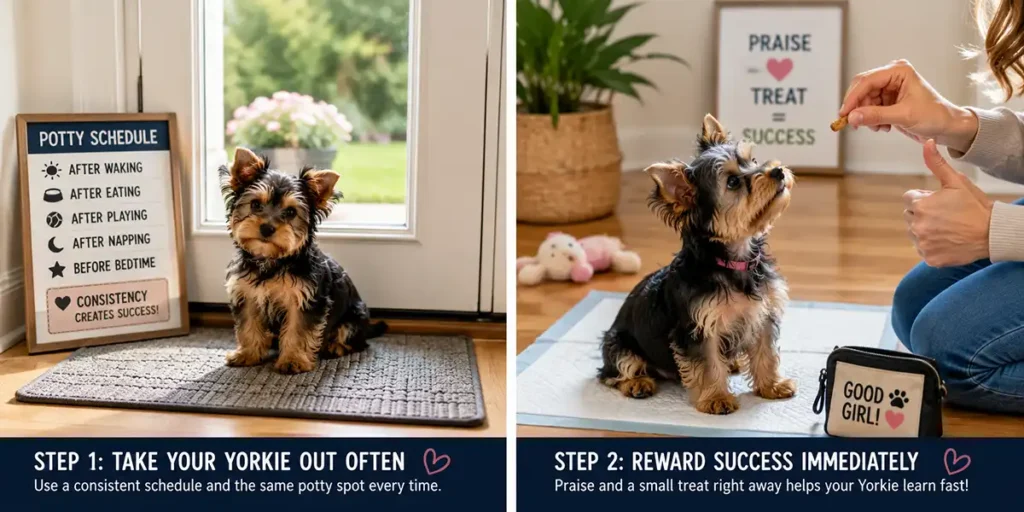
A schedule helps prevent accidents before they happen. Instead of waiting for your Yorkie to ask, take the dog to the potty area at predictable times throughout the day.
Take your Yorkie to the bathroom area:
- Immediately after waking
- Shortly after eating
- After drinking a larger amount of water
- After active play
- After leaving the crate or exercise pen
- After a nap
- Before bedtime
- Whenever you notice sniffing, circling or restlessness
Young puppies may need opportunities as frequently as every one to two hours while awake. As bladder control and training improve, the time between trips can gradually increase.
Use the Same Potty Location
Take your Yorkie to the same general location each time. Familiar scent and surroundings help communicate what the area is for.
For outdoor training, use the same door and walk directly to the designated spot. Keep the dog on a leash so the trip does not immediately turn into playtime.
For indoor training, keep the pad or potty tray in one dependable location. Avoid moving it around the house unless you are following a gradual relocation plan.
Add a Simple Potty Command
Choose a short phrase such as “go potty,” “bathroom” or “hurry up.” Use the same phrase calmly when your Yorkie reaches the correct location.
Do not repeat the phrase continuously. Say it once or twice, then wait quietly. Over time, your Yorkie can begin associating the words with the behavior.
A reliable potty cue can be especially helpful during bad weather, travel or bedtime outings.
Reward Your Yorkie Immediately
Timing is one of the most important parts of successful Yorkie potty training. Reward your dog immediately after finishing in the correct place.
Do not wait until you return indoors or walk into another room. By then, your Yorkie may not understand which behavior earned the reward.
Use enthusiastic praise and a very small treat. The reward should feel valuable enough that your Yorkie wants to repeat the behavior.
A pouch of tiny soft training treats for small dogs makes it easier to reward your Yorkie at exactly the right moment.
Supervise Your Yorkie Closely
Too much freedom too soon is one of the most common causes of house-training problems. Until your Yorkie is reliable, keep the dog in the same room with you or in a safely confined area.
Watch for early signs that your Yorkie needs to go:
- Sniffing the floor repeatedly
- Circling
- Walking away from play
- Heading toward a previous accident location
- Pacing or appearing distracted
- Moving toward the door
- Suddenly becoming restless
When you see these signs, calmly take your Yorkie to the correct bathroom area.
Use a Crate or Exercise Pen Appropriately
A crate or exercise pen can help manage your Yorkie when direct supervision is not possible. The goal is to prevent quiet accidents in hidden areas of the home.
A crate should be large enough for the dog to stand, turn around and lie comfortably. It should not be used as punishment or as an all-day holding area.
An exercise pen can provide additional space for a bed, water and an indoor potty station when needed. This may be especially useful for young puppies who cannot wait very long.
A small puppy exercise pen can help create a safe, manageable area during early Yorkie house-training.
What to Do When Your Yorkie Has an Accident
Accidents are part of the learning process. Your response can either help training move forward or create additional confusion.
If You Catch the Accident Happening
Interrupt calmly with a gentle sound, then take your Yorkie immediately to the correct potty location. If the dog finishes there, offer praise and a reward.
If You Find the Accident Later
Clean it without reacting to the dog. Your Yorkie will not understand punishment for something that happened several minutes earlier.
Never rub your dog’s nose in an accident, yell or use physical correction. Punishment can teach a Yorkie to hide while eliminating rather than teaching the correct location.
Clean Accidents Thoroughly
Dogs are naturally attracted to locations that smell like previous bathroom areas. Ordinary household cleaners may remove the visible stain without fully breaking down the odor.
Use an enzymatic pet stain and odor cleaner designed for urine and feces. Follow the product directions carefully and allow the area to dry completely.
Repeated accidents in one location often mean the scent remains, the area is too accessible or the dog is not being taken out frequently enough.
Should You Use Puppy Pads?
Puppy pads can be useful, but owners should decide what role they will play in the long-term routine.
Pads may work well for:
- Apartment living
- Severe weather
- Very young puppies
- Senior Yorkies
- Dogs with mobility limitations
- Households without quick outdoor access
If the long-term goal is outdoor potty training, relying on pads for too long may create confusion. Transition gradually by moving the pad closer to the door and eventually outside.
Do not scatter pads throughout the house. One clearly defined station is easier for a Yorkie to understand.
Potty Training During Cold or Rainy Weather
Many Yorkies dislike cold, rain or wet grass. Unfortunately, allowing the dog to skip bathroom trips whenever the weather is unpleasant can create inconsistent habits.
Keep weather-related potty trips short and purposeful. Use a sheltered area when possible, and reward success generously.
A properly fitted small-dog raincoat or warm sweater may help your Yorkie feel more comfortable during cold or wet outings.
Dry your Yorkie’s paws and coat after returning indoors.
Keep Meals on a Schedule
Scheduled meals make bathroom timing easier to predict. When food is available throughout the day, bowel movements may be less predictable.
Feed your Yorkie at consistent times based on age, health and veterinary guidance. After eating, take the dog to the bathroom area within an appropriate interval.
Always provide access to fresh water. Do not withhold water as a potty-training strategy unless a veterinarian has specifically instructed you to do so for a medical reason.
How Long Does It Take to Potty Train a Yorkie?
Some Yorkies show noticeable improvement within several weeks, while reliable house-training may take several months. Puppies need time to mature physically as well as learn the routine.
Progress is rarely perfectly straight. A puppy may do well for several days and then have an accident after excitement, a schedule change or too much freedom.
Do not assume the training is complete after one accident-free week. Continue supervising and rewarding correct behavior until the routine is firmly established.
Why a Previously Trained Yorkie May Have Accidents
A house-trained Yorkie may have an occasional accident because of stress, schedule disruption, unfamiliar surroundings or delayed bathroom access.
Repeated or sudden accidents may also indicate a health concern. Contact your veterinarian if your Yorkie develops:
- Frequent urination
- Straining to urinate
- Blood in the urine
- Excessive thirst
- Diarrhea
- Loss of bladder control
- Pain or vocalizing while eliminating
- Accidents during sleep
Medical problems cannot be corrected through training alone.
Common Yorkie Potty-Training Mistakes
- Waiting too long between bathroom breaks
- Giving full access to the house too soon
- Rewarding too late
- Changing the bathroom location repeatedly
- Punishing accidents
- Failing to clean with an enzymatic product
- Using an inconsistent verbal cue
- Expecting a puppy to have adult bladder control
- Ignoring signals such as sniffing and circling
- Stopping supervision before training is reliable
A Sample Yorkie Potty Schedule
A young Yorkie puppy’s day might include:
- Morning: Potty immediately after waking
- After breakfast: Return to the potty area
- After play: Potty break followed by a nap
- After waking: Immediate potty break
- After lunch: Potty break and supervised activity
- Afternoon: Additional trips every one to two hours as needed
- After dinner: Potty break
- Evening: Potty after play and before settling
- Bedtime: Final quiet potty trip
This is only a starting point. Adjust the schedule according to your puppy’s age, feeding routine and individual progress.
Yorkie Potty-Training Checklist
- Choose one primary bathroom location.
- Follow a predictable daily schedule.
- Take your Yorkie out after meals, naps and play.
- Use one simple verbal cue.
- Reward success immediately.
- Supervise closely indoors.
- Limit freedom until the dog is reliable.
- Clean accidents with an enzymatic cleaner.
- Never punish or frighten your Yorkie.
- Contact a veterinarian if accidents suddenly increase.
Final Thoughts: How to Potty Train a Yorkie Successfully
Successful Yorkie potty training depends on consistency, supervision and positive reinforcement. Take your Yorkie to the correct location frequently, reward success immediately and prevent unsupervised accidents whenever possible.
Some Yorkies learn quickly, while others need more time. Progress may feel slow, but every successful bathroom trip strengthens the habit you want.
Stay calm, follow the routine and remember that your Yorkie is learning a completely new set of household rules. With patience and repetition, your tiny companion can become reliably house-trained.