
Why Does My Yorkie Follow Me Everywhere? Understanding Velcro Yorkie Behavior
You walk into the kitchen—your Yorkie follows. You head to the bathroom—your Yorkie appears at the door. You sit down to work—and somehow your tiny Yorkshire Terrier is immediately curled up beside your feet.
If this sounds familiar, you are definitely not alone.
Many Yorkshire Terriers become extremely attached to their people. They are affectionate companion dogs that often want to know exactly where their favorite human is at all times.
So why does your Yorkie follow you everywhere? In most cases, the behavior comes from affection, habit, curiosity, security and the simple fact that being near you has become one of the most rewarding parts of your dog’s day.
However, there is a difference between a Yorkie that simply loves your company and a dog that becomes genuinely distressed whenever you leave the room.
This guide explains why Yorkies become little “Velcro dogs,” when the behavior is perfectly normal and how to encourage healthy independence without weakening the bond you share.
Are Yorkies Naturally Clingy?
Yorkies often form very strong bonds with their owners. They tend to enjoy being involved in household activity and may choose to spend much of the day close to their favorite people.
That does not necessarily mean anything is wrong.
Your Yorkie may simply see you as the center of its world. You provide meals, walks, play, comfort, grooming, affection and entertainment. From your dog’s perspective, following you is often a very successful strategy.
1. Your Yorkie Loves Being With You
The simplest explanation is often the correct one: your Yorkie enjoys your company.
Dogs are social animals, and many Yorkies develop particularly close relationships with the people who care for them every day.
If your Yorkie follows you calmly, settles when you stop moving and can still relax when you are not directly interacting, the behavior is usually just a sign of companionship.
2. Following You Has Become a Habit
Dogs quickly learn routines. If following you into the kitchen occasionally results in a snack, following you to the sofa leads to cuddles, and following you outside leads to a walk, your Yorkie learns that staying close often produces good things.
Over time, the behavior can become automatic.
Your Yorkie may not consciously be waiting for a reward every time. Being close to you has simply become part of the normal daily routine.
3. Your Yorkie Is Curious About What You Are Doing
Yorkies are observant little dogs. A person walking into another room may mean food, visitors, a walk, a toy or something interesting happening.
Following you allows your Yorkie to investigate.
For a curious dog, missing household activity may simply feel unacceptable.
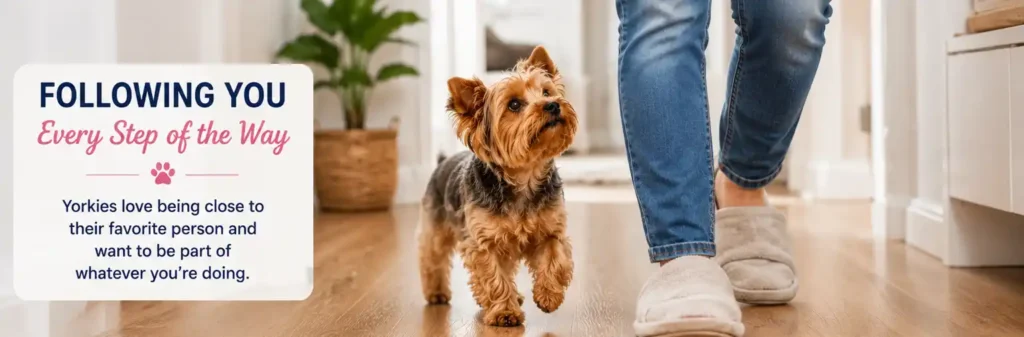
4. You Make Your Yorkie Feel Safe
Your presence can become a source of security. If your Yorkie encounters an unfamiliar noise, visitor or situation, staying close to you may help the dog feel more confident.
This can be particularly noticeable after:
- Moving to a new home
- Bringing home a new pet
- A major change in household routine
- A frightening experience
- Travel
- Boarding or staying away from home
- Changes involving family members
A temporary increase in attachment after a stressful event may settle as your Yorkie becomes comfortable again.
5. Your Yorkie May Have Learned That Following Gets Attention
Imagine that every time your Yorkie follows you, you look down, say their name, scratch behind the ears or pick them up.
From your Yorkie’s perspective, following you works wonderfully.
There is nothing wrong with giving your dog affection. The issue only becomes important if your Yorkie cannot relax without constant attention.
6. Yorkies Can Become Especially Attached to One Person
Some Yorkies enjoy everyone in the household but clearly choose one favorite person.
This may be the person who:
- Feeds the dog most often
- Provides most of the walks
- Handles training
- Works from home
- Allows the Yorkie to sleep nearby
- Provides the most affection
Over time, your Yorkie may simply spend more time following that person than anyone else.
Is Following You Everywhere a Problem?
Usually, no.
A Yorkie that happily follows you around but can also nap alone, eat normally, play independently and remain reasonably calm when you leave is probably just highly social.
The behavior becomes more concerning when your Yorkie appears unable to function comfortably without you.
Signs Your Yorkie May Be Too Dependent
Watch for behaviors such as:
- Becoming upset whenever you close a door
- Whining or barking immediately when you leave
- Refusing to remain with another family member
- Pacing when you prepare to leave
- Scratching at doors
- Following you constantly without ever settling
- Panicking when left alone
- Destructive behavior during your absence
- Potty accidents associated with being left alone
- Excessive panting or drooling after departure
These behaviors may indicate separation-related distress rather than simple affection.
Velcro Yorkie vs. Separation Anxiety
A Velcro Yorkie wants to be close to you.
A Yorkie experiencing separation anxiety may become distressed when you are gone.
That distinction matters.
A dog can follow you everywhere while you are home yet sleep peacefully for several hours after you leave. That dog is attached but may not be anxious.
Another dog may begin pacing the moment you pick up your keys and bark continuously after the door closes. That behavior needs more attention.
Should You Stop Your Yorkie From Following You?
You do not need to discourage normal affection.
The goal is not to make your Yorkie less attached. Instead, teach your dog that being close to you is wonderful—but being a few feet away is safe too.
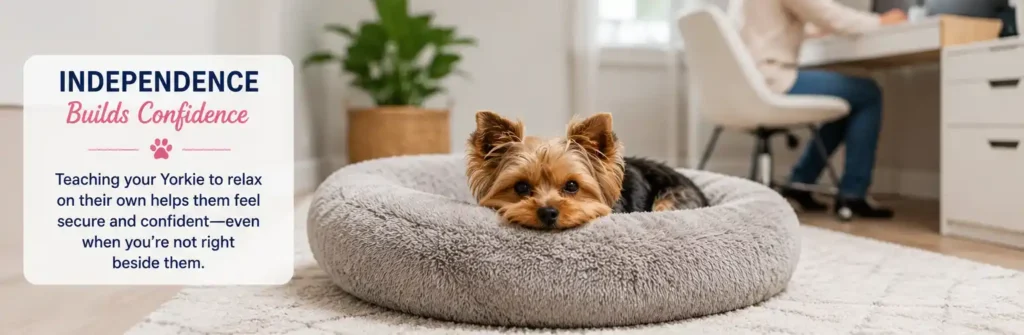
Teach Your Yorkie to Relax on a Bed
A designated bed or mat is one of the easiest ways to encourage independence.
Place a comfortable bed near you and reward your Yorkie whenever they settle there voluntarily.
Gradually increase the distance between the bed and where you are sitting.
A comfortable small orthopedic or calming bed for toy breeds can create an inviting place for your Yorkie to relax independently.
Practice Short Separations While You Are Home
You do not have to leave the house to practice independence.
Try walking into another room for a few seconds while your Yorkie remains somewhere comfortable.
Return calmly before your dog becomes upset.
Slowly increase the time apart.
These tiny practice sessions teach your Yorkie an important lesson: you disappearing from view does not mean anything bad is happening.
Give Your Yorkie Something Interesting to Do
Independent activities can help your Yorkie learn to enjoy time without constant interaction.
Try:
- Food puzzles
- Lick mats
- Safe chew toys
- Snuffle mats
- Treat-search games
- Rotating favorite toys
A small-dog puzzle toy can give your Yorkie something rewarding to focus on while you are nearby but not directly interacting.
Do Not Reward Every Demand for Attention
If your Yorkie constantly paws, barks or nudges you for attention, responding every single time can accidentally make the behavior stronger.
Instead, look for moments when your Yorkie is calm.
Quietly resting nearby?
That is a great time for affection.
Relaxing independently?
Reward that too.
Your Yorkie begins learning that calm behavior gets attention rather than constantly demanding it.
Give Your Yorkie Enough Exercise
A dog with unused energy may follow you because you are the most interesting thing happening in the house.
Daily walks, sniffing, play and short training sessions can make it easier for your Yorkie to settle afterward.
Physical activity should always be appropriate for your Yorkie’s age and health.
Mental Stimulation Matters Too
Yorkies are clever little dogs. If there is nothing interesting to do, following you around may become their primary entertainment.
Teach simple tricks, practice obedience, hide treats around a safe room or introduce puzzle toys.
Even five-minute training sessions can provide useful mental stimulation.
Why Does My Yorkie Follow Me Into the Bathroom?
For many owners, this is the ultimate Velcro Yorkie question.
Your dog does not understand why the bathroom should suddenly become a private human space.
From your Yorkie’s perspective, you walked away—and naturally they came too.
Unless the behavior causes distress when the door is closed, there is usually nothing unusual about it.
Why Does My Yorkie Follow Me but Not My Partner?
Your Yorkie may simply have developed a stronger routine with you.
If you provide most of the food, walks and attention, your dog may naturally spend more time nearby.
Your partner can strengthen their relationship by participating in feeding, play, walks and positive training.
Can a Yorkie Become More Clingy With Age?
Some senior dogs begin seeking more reassurance from their owners.
Changes in hearing, eyesight, mobility or confidence may make an older Yorkie more dependent on familiar people.
However, a sudden major change in attachment or behavior should not automatically be blamed on age.
If your normally independent Yorkie suddenly refuses to leave your side, appears confused or shows other behavioral changes, mention it to your veterinarian.
When Clinginess May Indicate a Health Problem
Dogs sometimes seek extra contact when they do not feel well.
Pay closer attention if increased clinginess occurs alongside:
- Reduced appetite
- Vomiting or diarrhea
- Limping
- Shaking
- Difficulty sleeping
- Unusual panting
- Low energy
- Restlessness
- Changes in drinking or urination
- Confusion
A sudden personality change can occasionally be one of the first signs that something is wrong.
Should Your Yorkie Sleep With You?
This is ultimately a household choice.
Many Yorkie owners enjoy sharing a bed with their dog. Others prefer the Yorkie to sleep in a separate bed nearby.
The important thing is that your Yorkie can also feel comfortable in an independent sleeping area when necessary.
Travel, veterinary stays, illness and other circumstances may eventually require your dog to sleep somewhere other than beside you.
A Healthy Independence Routine
A simple daily routine could include:
- A morning walk together
- Breakfast
- Independent rest on a bed or mat
- A short training session
- Independent puzzle-toy time
- Affection and play
- Short periods in separate rooms
- An evening walk
- Quiet family time
This provides plenty of companionship while also teaching your Yorkie that independence is normal.
Signs of Healthy Yorkie Attachment
- Your Yorkie enjoys being near you.
- Your dog follows you but can also settle alone.
- Your Yorkie eats and plays normally when you are not beside them.
- Your dog can stay comfortably with another trusted person.
- Short departures do not trigger panic.
- Your Yorkie enjoys independent toys and activities.
- Your dog appears relaxed rather than constantly worried.
When to Seek Professional Help
Consider speaking with your veterinarian or a qualified behavior professional if your Yorkie:
- Panics when left alone
- Destroys doors or windows trying to escape
- Barks or howls continuously
- Cannot settle without touching you
- Has repeated accidents only during separations
- Shows severe distress when you prepare to leave
- Suddenly becomes much more clingy than normal
Separation-related distress is not simply a dog being spoiled. Some dogs need a structured training plan and professional support.
Final Thoughts: Why Does My Yorkie Follow Me Everywhere?
Most of the time, your Yorkie follows you because you are their favorite person.
You represent food, walks, security, entertainment and—most importantly—companionship.
That close attachment is one of the wonderful things about sharing your life with a Yorkshire Terrier.
You do not need to stop your Yorkie from loving your company. Instead, balance that affection with small opportunities for independence.
Teach your Yorkie that following you is welcome—but resting comfortably on their own is safe too.
That balance creates exactly what we want: a deeply bonded Yorkie who feels secure whether they are curled up beside you or relaxing peacefully across the room.